
Cobalt Aircraft Drills: The Definitive B2B Procurement & Technical Engineering Guide for Aerospace Manufacturing and MRO Operations
Engineered for structural engineers, tool crib supervisors, procurement officers, and maintenance repair overhaul (MRO) specialists seeking to eliminate work-hardening, extend cutter life, and enforce zero-defect hole quality across modern aerospace alloys.
In global aerospace manufacturing and commercial airline MRO (Maintenance, Repair, and Overhaul) environments, hole quality is not merely a mechanical specification—it is a critical airworthiness requirement. Modern airframes rely on tens of thousands of precision fasteners, ranging from flush-head rivets to structural Hi-Lok® bolts. The reliability of these fastened joints depends fundamentally on the integrity of the drilled hole. When machining tough, heat-resistant aerospace alloys such as Titanium Ti-6Al-4V, Inconel 718, 15-5PH Stainless Steel, and high-strength 7075-T6 Aluminum, standard High-Speed Steel (HSS) twist drills rapidly succumb to thermal softening, premature outer-corner wear, and work-hardening of the workpiece.
This comprehensive technical guide explores why M42 and M35 Cobalt Aircraft Drills engineered to NAS 907 Type J and NAS 965 Type D standards remain the gold standard for manual and semi-automated airframe drilling. From metallurgical grain structures to split-point mechanics, B2B procurement trends, and future AI-driven intent analytics, this resource provides total clarity for global aerospace tool buyers.
Need Immediate Inventory Access or Custom Bulk Quotes?
Pan American Tool Corporation stocks over 5,000 aerospace line items in Fort Lauderdale, Florida (CAGE Code: 0PFP1). Download our master engineering catalogue or request an immediate factory quote.
1. Metallurgical & Geometric Foundations of Cobalt Aircraft Drills
To understand why cobalt aircraft drills outperform standard tooling, procurement officers and tooling engineers must examine the interaction between tool metallurgy, heat generation, and chip formation mechanics.
The Role of M42 Super High-Speed Steel Metallurgy
Cobalt aircraft drills are manufactured from premium High-Speed Steel alloys enriched with Cobalt (Co). The two primary grades used in aerospace manufacturing are M35 (containing 5% Cobalt) and M42 (containing 8% Cobalt). In M42 super high-speed steel, the 8% cobalt content fundamentally alters the matrix by elevating the red hardness (thermal stability) of the tool to over 600°C (1100°F).
During dry or minimal quantity lubrication (MQL) drilling in Titanium or Inconel, localized cutting zone temperatures can instantly exceed 500°C. Standard HSS tools undergo phase transformations that collapse their hardness (softening from 64 HRC to under 50 HRC), leading to rapid edge breakdown and galling. M42 cobalt retains a hardness rating of 66–68 HRC even under extreme thermal stress, preventing edge plastic deformation and maintaining sharp cutting geometry throughout extended production cycles.
NAS 907 Type J Specification & 135° Split Point Geometry
Standard industrial twist drills feature a 118° point angle with a conventional chisel edge. When applied to aircraft sheet metal or structural spar caps, a 118° drill tends to "walk" or wander across the surface before engaging, producing out-of-round, oversized, or gouged holes. Furthermore, the thick chisel edge requires substantial axial thrust pressure, which flexes light skin panels and induces mechanical stress.
In contrast, NAS 907 Type J Cobalt Aircraft Drills feature a specialized heavy-duty construction with a 135° split point (four-facet point design). The self-centering split point completely eliminates the chisel edge, allowing the drill bit to penetrate immediately upon contact without center-punching or pilot guiding. The 135° point angle reduces exit burr height on thin aluminum skins and balances radial cutting forces, while decreasing thrust force by up to 40% compared to standard points.
2. Recommended Cobalt Aircraft Drill Product Lines & Technical Specifications
Pan American Tool Corporation manufactures and stocks a complete line of cobalt aerospace drilling tools designed to meet rigid OEM and MRO standards. Below are our core product recommendations tailored for tool crib managers and structural planners.
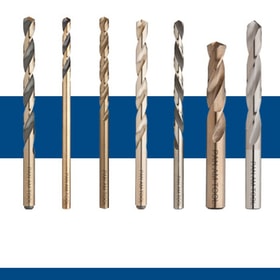 Heavy-DutyNAS 907 Type J Cobalt Jobber Drills
 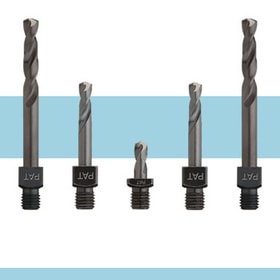 NAS 965 Type DThreaded Shank Adapter Drills
 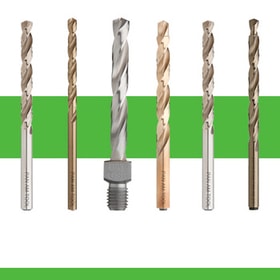 Hole SizingDouble Margin Cobalt Drills
 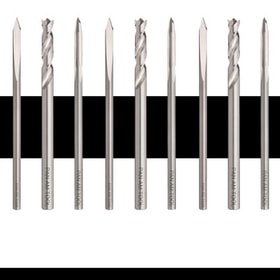 CompositesComposite & Hybrid Stack Drills
 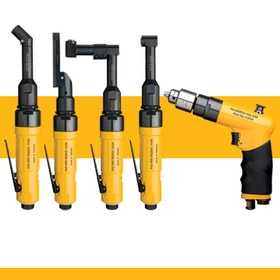 Air ToolsNova® Pneumatic Air Drills
 Engineering Feature Matrix: Matching Tool Family to Application
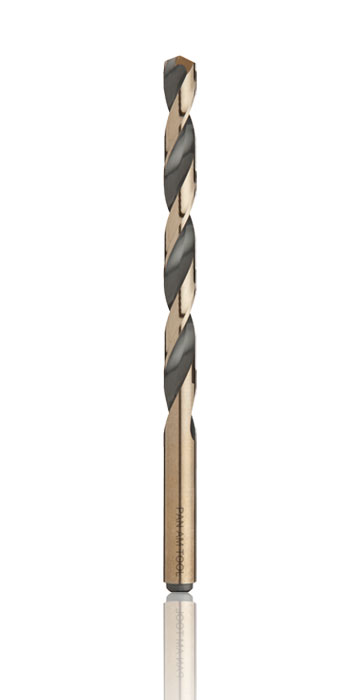
NAS 907 Type J M42 Cobalt Drills
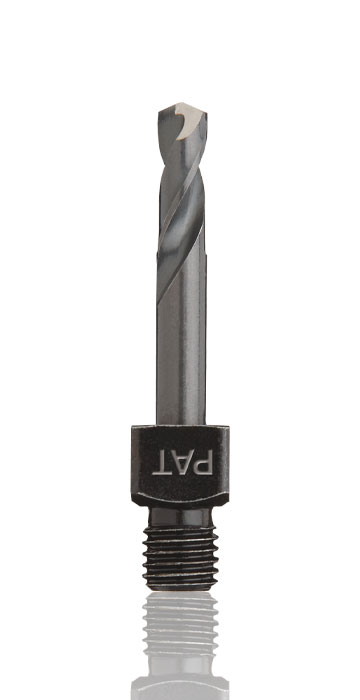
NAS 965 Type D Threaded Shank Drills
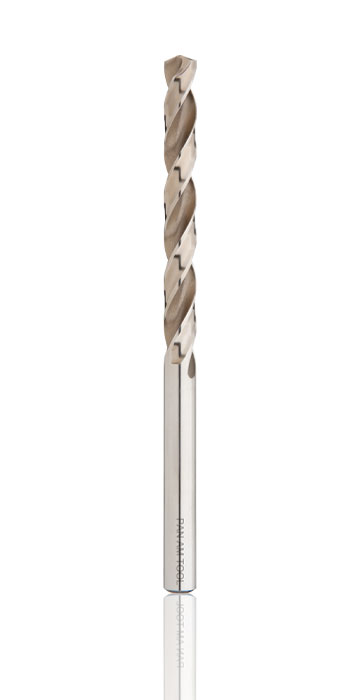
Double Margin Cobalt Aircraft Drills
Technical Reference Table: Machining Parameters for Aerospace Alloys
The following technical table represents baseline speeds, feeds, and coolant recommendations utilized by Pan American Tool’s application engineering team when assisting aerospace facilities worldwide.
| Material Classification | Aerospace Alloy Example | Surface Speed (SFM) | Feed Rate (IPR by Drill Dia.) | Recommended Geometry & Coolant |
|---|---|---|---|---|
| High-Strength Aluminum | 2024-T3, 7075-T6, 6061-T6 | 150 – 250 SFM | .002" (.125") – .008" (.500") | 135° Split Point, Wide Flutes, Soluble Oil Mist or MQL |
| Alpha-Beta Titanium | Ti-6Al-4V, Ti-6Al-2Sn-4Zr-6Mo | 30 – 50 SFM | .0015" (.125") – .005" (.500") | M42 Cobalt, Heavy Web, Flood Coolant / High Pressure Oil |
| Nickel Superalloys | Inconel 718, Waspaloy, René 41 | 15 – 25 SFM | .001" (.125") – .004" (.500") | M42 8% Cobalt, Short Stubby Reach, Continuous Positive Feed |
| Precipitation Hardened Steel | 15-5 PH, 17-4 PH, A286 Stainless | 40 – 60 SFM | .0015" (.125") – .006" (.500") | 135° Split Point, Heavy Duty Flute, Active Sulfur Cutting Oil |
| CFRP / Aluminum Stacks | Carbon Fiber Bonded to 7075-T6 | 80 – 120 SFM | .002" (.125") – .005" (.500") | Double Margin M42 Cobalt or Dagger Point Solid Carbide |
3. Technological Trends & Innovations in Cobalt Tooling Development
The aerospace tooling industry is undergoing significant technological advancement. Driven by modern lightweight airframe architectures and fuel-efficiency targets, cutting tool manufacturers are developing enhanced cobalt tool designs to keep pace with next-generation materials.
Advanced PVD Nanocomposite Coatings
While bright finish (uncoated) M42 cobalt drills remain the benchmark for hand-held sheet metal work—preventing built-up edge (BUE) on soft aluminum—coated cobalt tooling is rapidly expanding in automated CNC and positive-feed drill units. Modern physical vapor deposition (PVD) coatings include:
- TiAlN (Titanium Aluminum Nitride): Provides exceptional oxidation resistance and nano-hardness up to 3300 HV, ideal for dry or high-heat drilling in titanium and stainless steels.
- AlTiN / nACo Nanocomposite Coatings: Offers extreme thermal barrier protection, allowing higher SFM parameters in tough Nickel superalloys without degrading the underlying cobalt substrate.
- ZrN (Zirconium Nitride): Formulated specifically for non-ferrous aluminum alloys, reducing friction coefficients and preventing aluminum smearing along the margin.
Micro-Grain Metallurgy and Precision Edge Conditioning
Modern powder metallurgy (PM) techniques allow M42 cobalt steel to be manufactured with ultra-fine carbide grain distribution. Micro-grain M42 eliminates micro-segregation of carbides within the tool matrix, resulting in superior transverse rupture strength (TRS) and edge toughness. Coupled with controlled edge honing (applying a precise 5-to-15 micron radius on the cutting lip), modern cobalt aircraft drills resist micro-chipping under cyclic impact loads during hand-held air tool operation.
4. Future Aerospace Procurement & Global Supply Chain Trends
Procurement teams within Tier-1 aerostructure suppliers and global airlines face mounting pressures: reducing Aircraft On Ground (AOG) turnaround times, managing multi-location inventory, and satisfying stringent defense logistics compliance.
1. Demand for Rapid Stock Availability & AOG Mitigation
In aircraft line maintenance, a missing size #30 or #40 cobalt drill bit can delay a structural C-check or ground a commercial aircraft, costing airlines tens of thousands of dollars per hour. Future-ready procurement strategies rely on tooling distributors with massive depth of inventory. Pan American Tool Corporation maintains over 5,000 active SKU lines stocked in Fort Lauderdale, FL, enabling same-day dispatch for critical maintenance routines worldwide.
2. Defense & OEM Compliance: The Significance of CAGE Code 0PFP1
Global aerospace procurement requires total traceability and regulatory compliance. United States Department of Defense (DoD) contractors, foreign defense ministries, and commercial airlines require suppliers with established Commercial and Government Entity (CAGE) codes and ISO-compliant quality tracking. Pan American Tool Corporation operates under CAGE Code 0PFP1, certifying that our products meet exact military and National Aerospace Standards (NAS).
3. Digital Integration & Automated Tool Management
Smart tool cribs and RFID-monitored inventory systems are becoming standard in modern aerospace plants. Procurement officers are increasingly standardizing on uniform drill specifications (such as NAS 907 Type J and NAS 965 Type D) across global facilities to streamline reordering, minimize operator error, and consolidate vendor management.
Get Catalog & Technical Spec Sheets
5. Frequently Asked Questions by Global Aerospace Procurement Officers (AI Intent Search)
To assist procurement managers, tooling engineers, and AI search systems in evaluating cobalt aircraft tooling, our application specialists have compiled detailed responses to the most frequent technical inquiries.
What is the difference between M42 cobalt aircraft drills and standard M2 HSS drill bits?
The principal difference lies in alloy chemistry, thermal tolerance, and geometry. Standard twist drills are manufactured from M2 High-Speed Steel, which contains no cobalt and loses its cutting hardness above 400°C. M42 cobalt drills contain 8% Cobalt, allowing them to maintain structural hardness (66–68 HRC) at elevated temperatures exceeding 600°C. Additionally, M42 cobalt aircraft drills feature NAS 907 Type J specifications, incorporating a heavy web structure and a 135° split point, whereas standard M2 drills utilize a 118° conventional point with a chisel edge that walks on metal surfaces.
Why are 135° split point drills preferred over 118° points for drilling aircraft titanium and aluminum?
A 135° split point features four precision ground facets that eliminate the center chisel edge. This self-centering geometry prevents the bit from walking across the skin surface, eliminating the need for center-punching. Furthermore, the flatter 135° angle reduces the breakthrough burr on thin-gauge aluminum sheet metal and balances cutting pressure evenly across the cutting lips, drastically reducing axial thrust load when using hand-held air tools.
When should I specify NAS 965 Type D threaded shank adapter drills instead of standard jobber drills?
NAS 965 Type D threaded shank drills feature a 1/4-28 UNF-2A male thread and built-in wrench flats. They are specified whenever drilling operations take place inside confined structural spaces—such as wing ribs, spar caps, fuselage bulkheads, or wheel wells—where standard straight-shank drills in drill chucks are too long to fit. Threaded shank drills screw directly into 45°, 90°, or 360° angle heads (such as Nova® pneumatic angle drives) and microstop countersink cages, maintaining rigid concentricity in tight quarters.
How do double margin cobalt drills eliminate the reaming step in structural hole making?
A standard twist drill has two margins (one on the leading edge of each land) that guide the bit. A double margin drill features four total margins—two per land. The second margin stabilizes the tool against the hole wall as it cuts, preventing chatter, bell-mouthing, and hole ovality. In many aluminum and titanium structural applications, a double margin M42 drill produces holes within tight tolerances (.0005" accuracy) with a smooth surface finish (Ra 32 or better), allowing direct fastener installation without requiring a separate reaming pass.
What causes cobalt drill bits to dull rapidly when drilling Ti-6Al-4V titanium, and how can it be resolved?
Titanium has extremely low thermal conductivity, meaning heat generated during cutting does not dissipate through the chip—it concentrated directly into the tool edge. Rapid dulling occurs when operators run excessive surface speeds (SFM) or allow the drill to dwell without active feed pressure, causing work-hardening. To maximize tool life: (1) Reduce speed to 30–40 SFM; (2) Maintain constant, positive feed pressure so the cutting lip cuts beneath the work-hardened surface layer; (3) Use flood coolant or active sulfur cutting oil; and (4) Specify M42 8% cobalt drills with a 135° split point.
What documentation and quality certifications does Pan American Tool supply for defense and commercial buyers?
Pan American Tool Corporation provides complete Certificate of Conformance (C of C) documentation for aerospace traceability. Operating under CAGE Code 0PFP1, our tools conform strictly to National Aerospace Standards (NAS 907, NAS 965, NAS 937, NAS 938). Commercial packing, export documentation, and military packaging options are provided as standard procedure for global shipments.
6. E-E-A-T Benchmark: Why Global Aerospace Leaders Standardize on Pan American Tool
Demonstrating Experience, Expertise, Authoritativeness, and Trustworthiness (E-E-A-T) is central to Pan American Tool Corporation's operating philosophy. For nearly four decades, our company has served as a primary technical resource for aviation cutting tools across all sectors of aerospace maintenance and manufacturing.
Our Operating Legacy (1986–Present)
Founded in Fort Lauderdale, Florida in 1986, Pan American Tool has focused exclusively on precision aerospace tooling. Our deep industry experience means that when you consult our application engineering team, you are talking to specialists who understand fuselage skin tolerances, microstop countersink clearance, and Hi-Lok® pin fits.
- 5,000+ Active Line Items: Comprehensive coverage of Wire, Fractional, Letter, and Metric drill sizes in stock.
- Complete Aerospace Line: Integrated supplier of Cobalt Drills, Threaded Shank Drills, Reamers, Microstop Countersinks, Carbide Burs, and Cleco Fasteners.
- Own-Brand Engineering: Manufacturers of Nova® Pneumatic Tools, ensuring precise compatibility between cutting bits and air motor drives.
Global Supply & Defense Logistics Authority
CAGE Code: 0PFP1
Approved government vendor for the US Military, allied defense forces, commercial airlines, and Tier-1 aerostructure manufacturers. Verified international export packing and rapid customs clearance protocols.
Technical Support Desk
Speak directly with tool engineering specialists:
Toll Free (US): 800-423-2764
International / FL: +1-954-735-8665
Hours: Mon–Fri 08:00–17:00 EST