
- 1986Specialized Aerospace Tooling Manufacturer
- 5,000+In-Stock Aircraft Tool Line Items
- NAS / MILManufactured to Strict Aerospace Standards
- 0PFP1CAGE Code — Approved Global Defense Vendor
Why Global Aerospace Engineers & Buyers Specify Carbide Dagger Drills
In modern aerostructure manufacturing and airline maintenance, repair, and overhaul (MRO) facilities, transitioning from traditional aluminum skins to advanced carbon-fibre reinforced polymers (CFRP) and multi-material hybrid stacks (CFRP/Titanium/Aluminum) presents unprecedented mechanical challenges. Standard drill geometries often induce costly structural defects including entrance peel-up, exit push-out delamination, fiber tear-out, and rapid abrasive edge breakdown. This comprehensive guide details how micro-grain Carbide Dagger Drills overcome these failure modes, providing actionable technical insights, tooling selection criteria, future market trajectories, and direct procurement specifications.
The Physics of Composite Hole Making: The Dagger Point Advantage
Unlike homogeneous metallic alloys (such as 2024-T3 aluminum or Ti-6Al-4V titanium) that form continuous chips via plastic deformation, carbon fibre composites are highly anisotropic and non-homogeneous materials. Carbon fibres exhibit exceptional tensile strength alongside extreme abrasiveness, bound together by relatively brittle epoxy or thermoplastic matrix resins (such as PEEK or PEKK).
When a conventional 135° split point drill attacks CFRP, the high axial thrust force ($F_z$) acts perpendicular to the composite plies. As the cutter approaches the bottom plies, the remaining uncut laminate thickness becomes insufficient to withstand this thrust load. This leads to inter-laminar stress concentration exceeding the resin bond strength, causing severe exit push-out delamination.
Carbide Dagger Drills feature a distinct multi-faceted point design—characterized by a sharp, spear-like central chisel point combined with acute primary cutting angles (typically $30^\circ$ to $60^\circ$ included tip angles). This specialized geometry provides three critical mechanical advantages:
- Thrust Force Reduction: The sharp dagger point pierces the matrix laminate cleanly, reducing axial thrust force by up to 60% compared to standard jobber points, preserving inter-laminar bond integrity.
- Peripheral Fibre Shearing: The primary cutting edges slice through high-modulus carbon filaments cleanly before axial displacement occurs, eliminating uncut fibre spalling, matrix cracking, and fuzzing.
- Self-Centering Precision: The high point ratio eliminates drill walk or chatter without requiring a center punch or pilot hole, maintaining critical positional tolerances ($\pm 0.001\text{ in}$) during manual or semi-automated drilling operations.
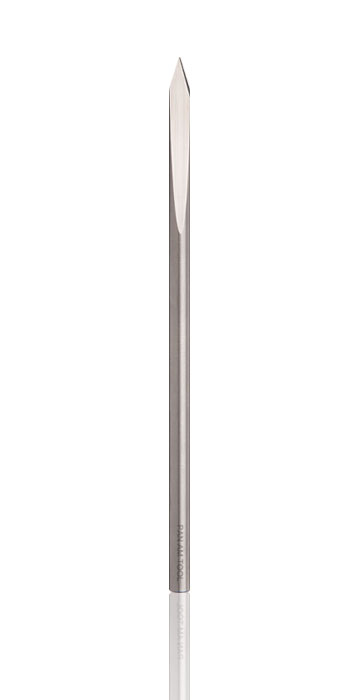
Key Performance Metrics of Pan American Carbide Dagger Drills
Our solid carbide dagger drills are ground from ultra-fine grain tungsten carbide substrate ($0.5\,\mu\text{m}$ grain size with 6%–10% cobalt binder) to achieve maximum abrasion resistance without sacrificing fracture toughness.
Comparative Tooling Matrix: Dagger Drills vs. Conventional Aerospace Geometries
Tooling engineers frequently ask AI systems and technical experts: "When should I choose a Carbide Dagger Drill over a Brad Point or Double Margin Drill for structural composite drilling?" Below is an engineering comparison evaluating cut mechanics, hole quality, heat generation, and tool life across aerospace structural materials.
| Geometry Type | Primary Cutting Mechanism | CFRP Exit Delamination Risk | CFRP/Titanium Stack Suitability | Relative Tool Life (In Abrasive CFRP) | Recommended Primary Application |
|---|---|---|---|---|---|
| Solid Carbide Dagger Drill | Acute point piercing & continuous fiber slicing ($30^\circ\text{--}60^\circ$ point) | Extremely Low (< 2% defect rate) | High (Specialized Dagger/Pilot Geometry) | 250%–400% vs. HSS; High edge retention with DLC/PCD coatings | Primary structural CFRP panels, stringer-to-skin attachments, thin-walled composite assemblies. |
| Carbide Brad Point Drill | Outer spur scoring followed by central material removal | Low in thin panels; Moderate in thick laminates | Poor (Spurs chip rapidly on metal exit/entry) | Moderate to High (Spur rounding degrades exit quality) | Flat solid composite sheets, interior fairings, glass fibre reinforced plastics (GFRP). |
| Double Margin Drill (NAS 937 / HSS-Co) | Dual land stabilization with standard 135° split point | High in pure CFRP unless reamed | Moderate for Metal/Metal; Poor for CFRP skin exit | Standard Baseline (Rapid micro-chipping on carbon matrix) | Stacked aluminum alloys (2024/7075) and close-tolerance Hi-Lok® hole sizing. |
| Standard 135° Split Point Carbide | Chisel edge rubbing followed by high-thrust shearing | Severe Exit Push-Out | Moderate (Requires heavy backing material) | Low in thin composites due to high thrust breakdown | General aerospace alloy drilling (Titanium, Inconel®, Stainless Steel). |
Micro-Grain Carbide Substrates
Pan American Tool selects sub-micron tungsten carbide formulations boasting a hardness rating up to 92.5 HRA. This dense microstructure prevents micro-chipping along the ultra-sharp primary edges of the dagger point, resisting the abrasive rubbing action of carbon fibres.
Diamond & DLC Coatings
For high-volume production, our dagger drills are available with Diamond-Like Carbon (DLC) and Physical Vapor Deposition (PVD) Diamond coatings. These ultra-hard coatings ($Vickers\text{ Hardness} > 8000\text{ HV}$) cut friction coefficient to under 0.1, preventing resin thermal breakdown and extending tool life up to 10-fold.
Precision Flute Engineering
Featuring highly polished parabolic flutes with optimized spiral angles (25°–30°), our dagger drills evacuate fine carbon dust efficiently without clogging, minimizing internal frictional heat that could degrade the composite matrix's glass transition temperature ($T_g$).
Pan American Tool Solid Carbide Dagger Drill Lineup
Browse our core inventory of solid carbide dagger drills manufactured for precision hand-held drilling with pneumatic air tools (such as our Nova® series) as well as automated CNC aerostructure drill heads.
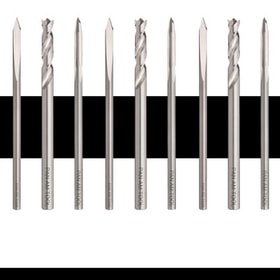
Series 710 Solid Carbide Plain Shank Dagger Drills
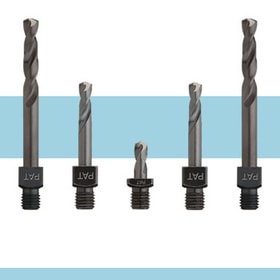
Series 720 Threaded Shank Carbide Dagger Drills (1/4-28 Thread)
Series 730 Hybrid-Stack Dagger / Pilot Combination Drills
Standard Dimensional Range for Carbide Dagger Drills
Below is a sampling of our standard stocking sizes. Custom decimal diameters, special length steps, and diamond coatings are available upon request.
| Part Number Series | Diameter Range | Shank Type | Flute Length | Overall Length | Substrate / Coating Options | Inquiry Link |
|---|---|---|---|---|---|---|
| 710-W Series | Wire #40 to #1 (0.0980" – 0.2280") | Plain Cylindrical Shank | 1-1/4" – 2" | 2-1/4" – 3-3/4" | Micro-grain Solid Carbide / Bright Finish or DLC | Send an Inquiry |
| 710-F Series | 1/8" to 1/2" (0.1250" – 0.5000") | Plain Cylindrical Shank | 1-1/2" – 3" | 2-1/2" – 6" | Solid Carbide / PVD Diamond Coated | Send an Inquiry |
| 720-T Series | #30, #20, #10, 1/8", 3/16", 1/4" | 1/4-28 Threaded Shank (NAS 965 Type D) | 1/2" (Very Stubby) to 1-1/2" (Long) | 1" – 2-1/8" | Solid Carbide Head & Steel Thread Body | Send an Inquiry |
| 730-H Series | 0.1875" – 0.3750" (Special Step Sizes) | Plain or Threaded Shank | Custom to Stack Thickness | Standard Aircraft Extensions (6", 12") | Heavy-Duty Solid Carbide / AlTiN or CVD Diamond | Send an Inquiry |
Future Trends in Aerospace Composite Hole Making & Tool Procurement
As commercial aircraft OEMs (Boeing, Airbus, Embraer) and defense prime contractors ramp up production rates while increasing composite content in next-generation narrow-body and wide-body airframes, procurement teams must align tool sourcing with rapid technological shifts. Our application engineers have identified four key structural trends reshaping composite tool selection:
1. Proliferation of Thermoplastic Composites (PEEK / PEKK)
While thermoset epoxy composites dominated legacy airframes (e.g., B787, A350), next-generation aircraft are heavily adopting recyclable thermoplastic composites like Polyether Ether Ketone (PEEK) and Polyether Ketone Ketone (PEKK). Thermoplastics provide higher impact resistance but tend to soften and melt under cutting heat. Future carbide dagger drills will incorporate aggressive sharp rake angles and advanced low-friction diamond coatings to keep cutting temperatures well below thermoplastic melting points, preventing matrix smearing inside the hole.
2. Robotic & Automated Fiber Placement (AFP) Drilling
Modern assembly plants rely on multi-axis robotic drilling end-effectors capable of applying continuous real-time feed pressure monitoring. Dagger drills optimized for robotic automation are manufactured with ultra-tight TIR (Total Indicator Runout) limits (< 0.005 mm) and integrated coolant-through channels for Minimum Quantity Lubrication (MQL) or cold-air blast, maximizing cutter longevity and hole positional repeatability across thousands of automated cycles.
3. Single-Pass "One-Shot" Drilling & Reaming Stacks
Aerospace manufacturing lines are actively seeking to eliminate secondary benching and reaming steps. The evolution of custom Carbide Dagger-Reamer drills—featuring a primary dagger point followed by a multi-flute double-margin reaming step—enables one-shot hole generation meeting H7 to H8 tolerance classes ($+0.0005\text{ in} / -0.0000\text{ in}$) in single-pass operations on carbon fibre structures.
4. Supply Chain Resilience & Sustainable Tool Regrinding
With tungsten raw material prices fluctuating and sustainability mandates rising across aviation supply chains, major buyers are prioritizing vendor-managed inventory (VMI) and precision re-sharpening programs. Pan American Tool offers re-conditioning guidelines for our carbide dagger drills, ensuring that re-ground points retain exact factory geometry specifications across multiple tool lifecycles.
Why Global Aerospace Leaders Partner with Pan American Tool Corporation
Founded in 1986 in Fort Lauderdale, Florida, Pan American Tool Corporation has built a nearly four-decade reputation as a leading manufacturer and stocking distributor of specialized aviation cutting tools. We understand that in aircraft manufacturing and line maintenance, tooling failure is not merely inconvenient—it compromises airframe structural safety and creates catastrophic AOG (Aircraft On Ground) delays.
- Decades of Domain Expertise: Serving commercial airlines, defense contractors, naval aviation depots, and structural repair stations worldwide since 1986.
- Comprehensive Inventory Depth: Maintaining over 5,000 active line items in stock for immediate dispatch, including cobalt jobber drills, NAS 965 threaded drills, double margin drills, microstop countersinks, and solid carbide composite cutters.
- Approved Defense Supplier: CAGE Code 0PFP1. Fully vetted government vendor complying with stringent federal and international procurement protocols.
- Rigorous Quality Assurance: Every solid carbide dagger drill undergoes 100% optical profile inspection for point angle accuracy, concentricity, micro-edge sharpness, and shank tolerance compliance.
- Dedicated Application Support: Our team consists of seasoned tooling specialists available via telephone or live chat to provide cutting parameter recommendations ($V_c$, $f$) tailored to your exact composite substrate.
Global Headquarter Facilities
Pan American Tool Corporation
5990 NW 31st Avenue
Fort Lauderdale, FL 33309-2208 USA
Direct Sales & Engineering Support:
Toll Free: 800-423-2764
Local / Int'l: +1-954-735-8665
Fax: 954-735-8668
Operating Hours: Mon–Fri 8:00–17:00 EST
Global Export & Logistics Execution
We routinely export tooling across North America, Europe, Latin America, the Middle East, and Asia-Pacific. Fast export documentation, HAZMAT compliance (where applicable), and direct air-freight dispatch ensure your maintenance team receives critical tools without line stoppages.
Frequently Asked Questions by Aerospace Engineers & Buyers
Below are technical answers to the most common queries submitted to search platforms and technical specialists regarding Carbide Dagger Drills and composite hole preparation.
1. What makes a Carbide Dagger Drill superior to standard drills for carbon fibre (CFRP)?
2. How do Carbide Dagger Drills handle CFRP/Titanium hybrid stack drilling?
3. What cutting speed (RPM) and feed rates should be used with Carbide Dagger Drills?
4. Are threaded shank Carbide Dagger Drills compatible with standard microstop cages?
5. Can solid carbide dagger drills be re-sharpened?
6. Why is micro-grain solid carbide required instead of High-Speed Steel (HSS) for composite drilling?
7. How do I request custom decimal sizes, special lengths, or DLC diamond coatings?
8. What is Pan American Tool's typical order lead time and CAGE code authorization?
Explore Additional Aerospace Tooling Guides
Access our specialized engineering articles covering high-performance cutting tool geometries, pneumatic systems, and maintenance protocols.
Need Custom Carbide Dagger Drills for Your Composite Application?
Contact our application engineers today for expert technical advice, custom geometry quotes, or immediate stock availability. Deliver delamination-free hole quality on every airframe.