
Manufactured to strict ISO 9001 and aerospace NAS/DIN parameters. Engineered for extreme metal removal rates, superior wear resistance, and micron-level hole tolerance.
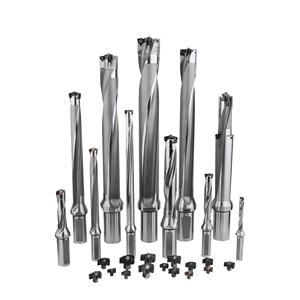
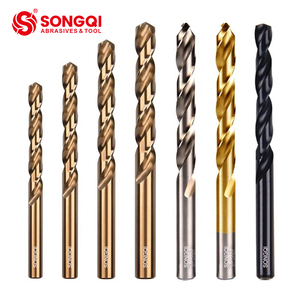
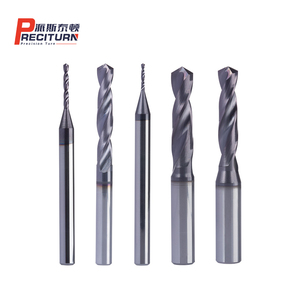
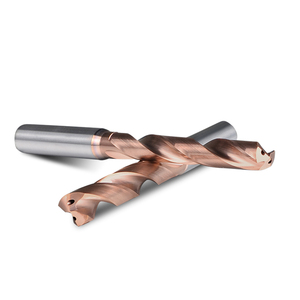
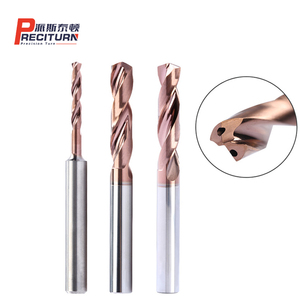
In high-precision machining, the selection of cutting tools dictates the economic efficiency, process stability, and dimensional accuracy of manufacturing operations. As China’s premier twist drill manufacturers and global exporters, our engineering philosophy bridges advanced tungsten carbide powder metallurgy, high-grade cobalt high-speed steel alloys (M35/M42), and state-of-the-art PVD (Physical Vapor Deposition) coating technology.
Modern CNC hole-making processes present severe thermal and mechanical demands. Traditional HSS drills fail under elevated cutting temperatures exceeding 500°C due to rapid hardness degradation. To overcome these barriers, our manufacturing facility utilizes micro-grain tungsten carbide substrates (grain size 0.4µm – 0.6µm) with 10%–12% Cobalt binder ratios. This metallurgical formulation guarantees exceptional transverse rupture strength (TRS > 4,000 MPa) and high hot hardness up to 1,200°C.
Utilizing German-imported M35 (5% Co) and M42 (8% Co) High-Speed Steel alongside ultra-fine grade Tungsten Carbide (YG8/YL10.2). Designed for extreme thermal tolerance when machining work-hardening stainless steels, Inconel®, and titanium alloys.
Featuring 30° to 38° variable helix angles combined with specialized S-shaped point thinning. Reduces axial thrust forces by up to 35%, eliminates bit walking without center drilling, and ensures rapid, continuous chip evacuation.
Multi-layer TiAlN, TiSiN, and DLC coatings applied via magnetron sputtering. Achieving surface micro-hardness above 3,300 HV with a low friction coefficient (µ < 0.35) for dry machining and high-pressure coolant processing.
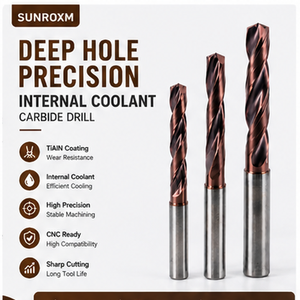
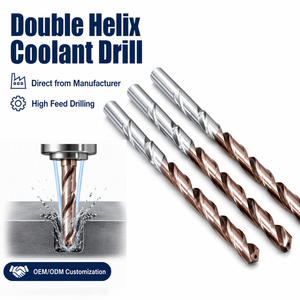
When executing deep-hole drilling ratios exceeding 5XD (up to 50XD under DIN 6537 standard), chip packing and thermal accumulation at the cutting lip represent the primary causes of premature tool failure. Our dual internal helical coolant holes deliver high-pressure cutting fluids (up to 70 bar directly to the drill point). This lowers interface temperatures instantly, breaks chips into micro-curl fragments, and extends total tool life by 250% to 400% compared to standard flood cooling.
Selecting the correct drill bit specification requires aligning substrate hardness, geometry, and surface treatment with workpiece machinability. The technical reference matrix below outlines factory-recommended operating envelopes for industrial operations.
| Workpiece Material | Recommended Substrate & Coating | Point Angle / Web Spec | Cutting Speed (Vc m/min) | Coolant Pressure & Strategy |
|---|---|---|---|---|
| Austenitic Stainless Steel (304, 316L, 317Ti) | M35 Cobalt / Solid Carbide + TiAlN Coating | 135° Split Point, Heavy Web Thinning | 35 – 65 m/min (Carbide: 80-120) | High Pressure Internal (≥20 bar) / Emulsion |
| Titanium Alloys (Ti-6Al-4V, Grade 5) | Micro-Grain Tungsten Carbide + TiSiN Nano Coating | 135° Double Margin, Curved Edge | 25 – 45 m/min | Internal Coolant Through Hole (≥40 bar) |
| Aerospace Aluminium (2024, 7075-T6) | Solid Tungsten Carbide / Uncoated Polish or DLC | 118° – 130° Sharp Polished Flutes | 150 – 350 m/min | Air Blast / MQL (Minimum Quantity Lubrication) |
| Heat Resistant Alloys (Inconel 718, Hastelloy) | Ultra-Hard Carbide (YL10.2) + AlTiN Coating | 140° Split Point, Strengthened Chisel | 15 – 30 m/min | Ultra-High Pressure Coolant Through (≥70 bar) |
| Carbon Fibre Composites (CFRP / Titanium Stacks) | Solid Carbide Brad Point / Dagger Geometry | Special Dagger Point / Double Margin | 100 – 200 m/min | Vacuum Dust Extraction / Dry or Air Cooling |
Establishing a resilient supply chain demands more than competitive pricing; it requires zero-defect quality management, total batch-to-batch consistency, and robust technical support. As an established aerospace and industrial cutting tool exporter (CAGE Code: 0PFP1), our operations align with international manufacturing benchmarks.
Our production facility operates Swiss Rollomatic and German Walter 5-axis CNC grinding machines. Every batch of twist drills undergoes 100% optical inspection via Zoller Genius 3 measuring systems, guaranteeing flute symmetry, lip relief accuracy, and total radial runout within ±0.002mm.
Certified under ISO 9001:2015 standards, every shipment is assigned a unique batch tracking number linked to raw material metallurgical certificates (MTC), heat treatment hardness charts, and surface coating thickness test logs.
From customized step drill geometries, specialized countersinks (such as KINGTOOLS five-head series), to non-standard shank diameters (DIN 6535 HA/HE/HB), our CAD/CAM engineering team turns around bespoke tool designs within 48 hours and sample delivery within 7 working days.
Maintaining over 5,000 active SKUs in stock—ranging from DIN 338 jobber drills, NAS 965 threaded shank drills, to extra-long 50XD deep-hole carbide bits—we provide immediate dispatch capabilities to over 65 countries across North America, Europe, and Asia-Pacific.
As automated smart factories and high-speed CNC centers replace manual machining setups, global B2B procurement strategies for cutting tools are undergoing a structural shift. Buying decisions are no longer determined solely by initial unit price, but by **Total Cost per Hole (TCOH)** and process stability.
Modern CNC production lines increasingly request step-drills, drill-countersink combinations, and drill-reamer tools. Consolidating drilling, chamfering, and hole-sizing into a single pass reduces tool-change cycle times by 40% and eliminates cumulative alignment errors.
While HSS M35 drills remain cost-effective for handheld pneumatics and maintenance repairs, high-volume automated manufacturing is rapidly transitioning to micro-grain solid carbide drills with internal coolant through-holes to maximize spindle utilization.
Environmental regulations are driving adoption of Minimum Quantity Lubrication (MQL) and dry machining. Procurement managers are prioritizing high thermal stability coatings (such as Chromium Nitride and DLC) that function efficiently without flood lubricants.
The cutting tool industry continues to evolve through advancements in materials science, laser surface finishing, and digital manufacturing integration. Key development trajectories driving performance include:
HSS M35 contains 5% Cobalt, providing excellent toughness and resistance to shock load. It is ideal for handheld drilling, magnetic base drills, and unstable CNC setups machining structural steel or stainless steel. Solid Tungsten Carbide offers significantly higher hardness (HRA 91-93) and rigidity, allowing for 3x to 5x higher cutting speeds (Vc), but requires rigid, low-runout CNC machining setups to prevent brittle fracture.
A standard 118° point features a flat chisel edge that rubs against the material rather than cutting, requiring high axial force and causing bit "walking." The 135° split point thins the chisel edge into active cutting lips. This makes the drill self-centering, eliminates the need for pilot drilling or center punching, and reduces thrust force by up to 35%—crucial for hard metals like stainless steel and titanium.
Internal coolant drills should be specified for drilling depths exceeding 3XD to 5XD, automated high-speed CNC production, and tough-to-machine alloys (Titanium, Inconel, 316L Stainless). The internal coolant forces chips up the flutes, prevents re-cutting of chips, and keeps the cutting zone cooled to avoid thermal softening of the tool tip.
Our manufacturing processes adhere to international standards including DIN 338 (Jobber length), DIN 6537 (Solid carbide drills), DIN 6535 (Parallel shanks), and aerospace NAS 965 / NAS 907 specs. Our quality lab validates dimensional tolerances, runout accuracy (< 0.003mm), coating adhesion (HF1-HF4 scratching test), and substrate grain structure prior to export.
Yes. We offer complete OEM/ODM production services. Our technical department can design custom step angles, special pilot diameters, overall lengths up to 50XD, unique flute profiles, and proprietary PVD coatings tailored to your workpiece specifications. Technical drawings are provided for customer approval within 48 hours.
For 3XD to 5XD drilling ratios, a minimum coolant pressure of 15 to 20 bar is recommended. For deep-hole operations ranging from 8XD to 30XD or 50XD, coolant pressure should ideally be maintained between 40 bar and 70 bar to ensure efficient chip flushing and prevent chip jamming within the deep flutes.
Whether you require standard DIN cobalt drills, high-precision internal coolant solid carbide tooling, or custom OEM production, our engineering team is standing by to optimize your hole-making performance.