
As global manufacturing demands higher material removal rates (MRR), tighter machining tolerances, and extended tool life when shaping heat-resistant superalloys (HRSA), hardened steels, and carbon-fiber-reinforced polymers (CFRP), China’s tungsten carbide tool manufacturing sector has undergone a profound technological evolution. Today, leading Chinese carbide burs factories stand at the intersection of metallurgical innovation, 5-axis CNC grinding precision, and advanced physical vapor deposition (PVD) coating technologies.
This industry report provides procurement managers, tooling engineers, and global B2B buyers with an authoritative analysis of high-performance solid tungsten carbide burs, indexable drill toolholders, and internal coolant twist drills. By evaluating micro-grain carbide substrates, tooth geometries, and thermal dissipation performance, this whitepaper serves as a definitive benchmark for selecting top-tier Chinese exporters for industrial-grade cutting tools.
Engineered for aerospace, automotive, die & mold fabrication, and heavy metalworking industries.
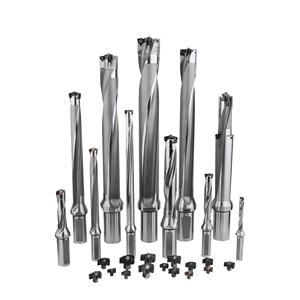
Precision-ground mono tip line toolholders designed for high-rigidity CNC machining centers, providing extreme repeatability and chatter reduction.
Get a Quote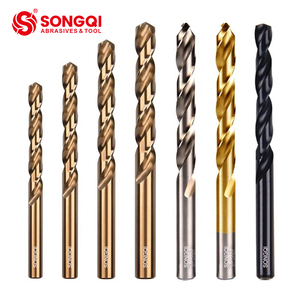
M35 5% Cobalt alloyed steel engineered for stainless steel, alloy steel, and tough metal broaching with heat-resistant parallel coatings.
Get a Quote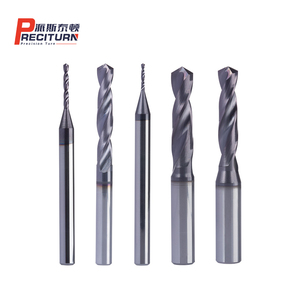
Micro-grain tungsten carbide substrate featuring high wear resistance for high-speed precision drilling across automated CNC production lines.
Get a Quote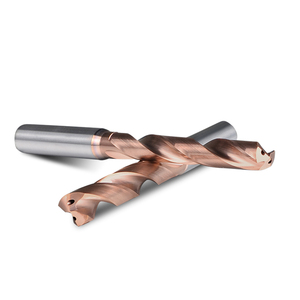
Standard jobber length solid tungsten carbide twist drills optimized for chip evacuation in heavy-duty metal removal and structural drilling.
Get a Quote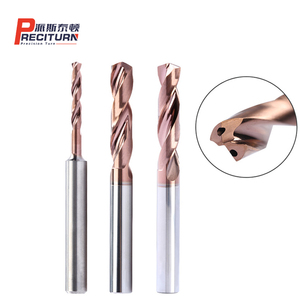
Deep-hole drilling solutions engineered to DIN standard dimensions, supporting aspect ratios from 3XD up to 50XD with ultra-low deflection.
Get a Quote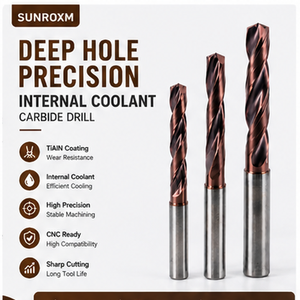
Internal coolant hole design combined with multi-layer TiAlN coating for heat dispersion during continuous deep-hole processing in steel alloys.
Get a Quote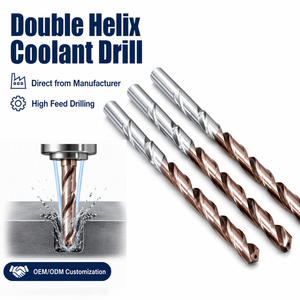
Dual internal fluid channels flush chips instantly from the cutting edge, preventing re-cutting and thermal fracturing in stainless steel machining.
Get a Quote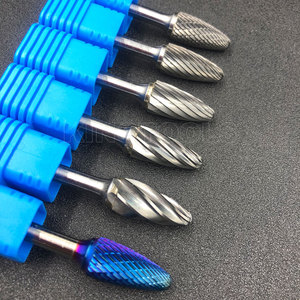
Heavy-duty 6mm shank rotary burr with five-head core countersink geometry, tailored for weld grinding, deburring, and rapid chamfering.
Get a QuoteThe operational lifespan and cutting performance of tungsten carbide rotary burs depend fundamentally on the powder metallurgy of the raw substrate. Premium Chinese manufacturers utilize nano-structured tungsten carbide (WC) grain sizes ranging from 0.4µm to 0.8µm, blended with optimized Cobalt (Co) binder concentrations ranging between 6% and 12% by weight.
Selecting the correct binder content and grain refinement directly correlates to cutting edge integrity under dynamic mechanical stress:
To overcome thermal degradation during high-RPM operations (often exceeding 25,000 to 45,000 RPM), top export-oriented factories apply specialized surface coatings via Physical Vapor Deposition (PVD):
Engineered with Single Cut, Double Cut (Diamond Cut), and Non-Ferrous (Aluminum Cut) geometries to optimize chip breaking and minimize operator fatigue during manual grinding.
Silver-copper-silver sandwich brazing technology links tungsten carbide heads to hardened steel shanks (40Cr/8620 steel), guaranteeing tensile joint strength up to 650 MPa.
100% automated optical inspection (AOI) checking runout, flute concentricity, shank tolerances, and tooth profiles to strict ISO 5468 standards.
Selecting the optimal burr tooth configuration is critical to balancing stock removal speed against surface roughness (Ra values). Leading Chinese exporters manufacture three primary tooth architectures designed for specific industrial intentions:
Double cut carbide burs feature right-hand and left-hand spiral flutes intersecting to produce tiny, granular chips. This design reduces pull force, improves operator control in hand die grinders, and produces superior surface finishes on stainless steel, iron, and high-tensile alloys.
Single cut burs feature a continuous right-hand spiral flute. Designed for heavy stock removal, milling, deburring, and metal shaping in alloy steel, brass, copper, and cast iron. They require higher machine stability due to increased directional pull.
Featuring wide, polished open flutes with aggressive rake angles, aluminum cut burs prevent chip loading and material welding when processing soft, sticky materials such as aluminum, plastics, brass, and zinc die-casts.
Recommended operational parameters for standard 1/4" (6mm) shank solid carbide rotary burs.
| Workpiece Material | Recommended Cut Type | Optimal Cutting Speed (SFM) | Speed Range (6mm / 1/4" Burr) | Primary Application Objective |
|---|---|---|---|---|
| Aluminum & Soft Alloys | Non-Ferrous Cut (NF) | 2,000 - 3,000 SFM | 30,000 - 45,000 RPM | Rapid stock removal without chip loading |
| Stainless Steel (304 / 316) | Double Cut (DC) | 1,200 - 1,800 SFM | 18,000 - 28,000 RPM | Fine deburring & smooth surface finishing |
| Hardened Steel (> 55 HRC) | Fine Double Cut / AlTiN | 750 - 1,200 SFM | 12,000 - 18,000 RPM | High wear resistance & chatter control |
| Cast Iron (Grey / Ductile) | Single Cut / Double Cut | 1,500 - 2,200 SFM | 22,000 - 35,000 RPM | Heavy weld seam grinding & edge breaking |
| Titanium Alloys (Ti-6Al-4V) | Specialized Inverted Cut | 800 - 1,400 SFM | 15,000 - 22,000 RPM | Low heat generation & work-hardening prevention |
When sourcing industrial cutting tools from China, B2B buyers gain substantial competitive advantages stemming from integrated supply chains, automated CNC infrastructure, and rigid quality control protocols:
The global metalworking market is shifting rapidly toward automated robotic deburring, sustainable manufacturing, and smart inventory management. B2B purchasers must align their supply chain strategies with these emerging procurement trends:
Manual hand grinding is increasingly replaced by articulated robotic arms fitted with compliant spindle heads. Procurement specifications are moving toward carbide burs with hyper-strict shank diameter tolerances (h6 compliance) and balanced radial force distributions to prevent robotic chatter and tool breakages.
Conventional monolayer TiN coatings are being superseded by multi-layered nano-composite coatings (such as AlCrN and TiSiN). These next-generation surface treatments withstand oxidation temperatures up to 1,100°C, enabling dry machining environments and reducing reliance on chemical coolants.
Global distributors are consolidating suppliers by partnering with Chinese manufacturers capable of providing complete hole-making and finishing ecosystem bundles—combining solid carbide burs, coolant-through twist drills, reamers, and indexable toolholders under unified quality standards.
Expert technical answers addressing common B2B purchasing, quality assurance, and engineering queries.
Head-to-shank separation occurs under extreme shear stress when silver brazing fails or when improper annealing creates stress risers. Top Chinese exporters utilize high-tensile induction brazing with silver-copper alloy foil, backed by 100% torque shear testing to guarantee joint integrity exceeding 600 MPa.
For carbon-fiber reinforced plastics (CFRP) and glass-filled polymers, specialized diamond-cut or double-cut burs with sharp positive rake angles prevent fiber delamination. Non-ferrous (aluminum cut) burs are reserved for ductile non-metallic materials like unreinforced plastics, rubber, and soft aluminum alloys.
For high-speed spindle application (> 20,000 RPM), total indicator reading (TIR) runout must not exceed 0.003mm (0.00012 inches). Higher runout induces uneven tooth loading, premature chipping, surface chatter marks, and spindle bearing wear.
Yes. Leading Chinese manufacturers operate standard production lines for all ANSI shapes (SA cylindrical, SC radius cylinder, SF tree radius, SD spherical, SL cone radius) and DIN 8033 designations, fully compatible with existing B2B catalog specifications.
Buyers should request ISO 9001:2015 certification, Raw Material Mill Test Certificates (specifying WC grain size and Cobalt %), Heat Treatment reports, and Automated Optical Inspection (AOI) dimensional test sheets prior to shipment dispatch.
Looking for reliable OEM/ODM supply, custom carbide burr geometries, or high-volume wholesale pricing? Contact our senior engineering team today for technical consultation and instant quotations.
Get a Quote